Powdery Mildew Treatment: What Works, Skip the Baking Soda
Skip the baking soda — it's the weakest fix. What works: 1 tbsp potassium bicarbonate per gallon of water, sprayed weekly, plus the ranked alternatives.
10 min read · Updated 2026-09-01
By PlantFix Editorial Team · Sources: University Extension Programs, USDA, EPA
How to Treat Powdery Mildew (Quick Answer)
Powdery mildew is a fungal disease that coats leaf tops with a white-to-gray powder. For fast, effective treatment, mix 1 tablespoon of potassium bicarbonate (not baking soda — more on that below) with 1 gallon of water and about ½ teaspoon of liquid soap, and spray all affected surfaces including leaf undersides. Remove and bag the worst-covered leaves, and get air moving around the plant. Repeat weekly.
The counterintuitive part: nearly every guide online tells you to spray baking soda, and it's the weakest option on the shelf. Potassium bicarbonate, a milk-and-water spray, neem oil, and sulfur all beat it in trials. Unlike most plant diseases, powdery mildew doesn't need wet leaves to spread — it thrives in crowding, poor airflow, and humid air, which is why spacing and a fan do as much as any spray.
How to Identify Powdery Mildew
Powdery mildew is one of the easier diseases to recognize once you know the tells.
What it looks like: white or pale-gray powdery patches, usually starting on the upper surfaces of leaves as small round spots that spread until they merge into a dusty coating. Badly affected leaves yellow, curl, and drop. On some plants it also dusts stems, buds, and flowers.
What it's not:
• Mealybugs look cottony and clustered in leaf joints, and they move or squash wet — mildew is a flat, dry film. If it's the former, our mealybugs guide has the fix.
• Hard-water/mineral deposits are crusty and located where water dries, not a spreading powder.
• Dust wipes off completely and doesn't come back; powdery mildew smears and returns.
• Downy mildew is the confusing cousin — it grows fuzzy and gray-purple on leaf undersides with yellow blotches on top, and it needs cool wet conditions. It's a different pathogen (a water mold, not a true fungus) and shrugs off some powdery-mildew treatments, so telling them apart matters.
One quick test: powdery mildew rubs partly off with a finger but comes right back, and it appears in the driest, most crowded, least-ventilated spots — the opposite of where you'd expect a fungus. If you're still not sure what the white marks are, our white spots on plant leaves guide walks through all six causes — mildew, mealybugs, mineral crust, sunburn, mite damage, and soil mold — with a wipe-test decision chart.
Why Baking Soda Doesn't Really Work (The Cornell Formula Myth)
Here's the myth-bust, because it will save you a summer of disappointment. The famous "baking soda spray" traces back to a real researcher — Dr. R.K. Horst at Cornell — who began testing sodium bicarbonate on powdery mildew and rose black spot in 1985. A gardening publication reported his work incompletely, other writers filled in a recipe and named it the "Cornell Formula," and it spread across the internet. The catch: Horst himself has said there is no official Cornell Formula, and later research undercut the sodium-bicarbonate part specifically.
When researchers tested plain sodium bicarbonate on its own, it underperformed. As Washington State University horticulturist Linda Chalker-Scott documents in her review of the evidence (Garden Professors), a field trial on lilac found baking soda alone failed to control powdery mildew and looked statistically no different from spraying plain water. Sodium bicarbonate can also burn foliage at higher concentrations, and repeated sprays build up sodium in the soil and leaf tissue — the opposite of helpful.
The fix was already known to the people who commercialized it. When EPA-registered bicarbonate fungicides came to market, none were built on baking soda — the formulators had run the comparison and chosen potassium bicarbonate on purpose, because it works better and supplies potassium (a plant nutrient) instead of sodium. So the correction is simple: swap the sodium bicarbonate in that famous recipe for potassium bicarbonate, and you've turned the weakest treatment into one of the strongest.
5 Powdery Mildew Treatments That Actually Work (Ranked)
In rough order of effectiveness and ease:
1. Potassium bicarbonate spray. 1 tablespoon per gallon of water plus a few drops of liquid soap as a spreader. This is what the branded organic mildew products (Kaligreen, MilStop, GreenCure) are built on. In one gooseberry study, weekly potassium-bicarbonate sprays held infection to about 10% of fruit versus over 90% in the untreated control. Spray every 7-10 days, coating both leaf surfaces.
2. Milk spray. Genuinely — this is university-tested, not folklore. Brazilian researcher Wagner Bettiol found that fresh cow's milk diluted to at least 10% in water, sprayed twice a week, cut powdery mildew severity on zucchini to about 10%, versus 56% in untreated plants — performance comparable to conventional fungicides in his greenhouse trial (published in Crop Protection, 1999). Mix roughly 1 part milk to 9 parts water. Don't go above about 30% milk, where a harmless surface fungus starts to grow.
3. Neem oil. Our neem oil guide covers it in depth; it works best as a preventive and on light infections, with the bonus of controlling soft-bodied pests at the same time. Don't spray it in hot sun or it can burn leaves.
4. Sulfur fungicide. The heavy-duty option for stubborn outdoor cases, especially on grapes, roses, and cucurbits. Never apply sulfur within two weeks of an oil spray or in high heat (above ~85°F) — it burns.
5. Copper fungicide. Broad-spectrum backup that also covers other diseases; see our copper fungicide guide. Useful when mildew is one of several problems on the same plant.
Whatever you pick, remove the worst leaves first, treat on a schedule rather than once, and pair the spray with better airflow. You can find the potassium bicarbonate, sulfur, and neem these call for on our recommended gear page.
Indoor vs. Outdoor Powdery Mildew
The pathogen behaves the same way, but the fix differs by setting because the cause differs.
Indoors, powdery mildew is almost always an airflow problem: crowded plants, stagnant air, and low light. The most effective single intervention is a small oscillating fan and more space between pots — that alone stops most indoor outbreaks, with a potassium-bicarbonate or milk spray to clean up existing infection. Susceptible houseplants include begonias, African violets, jade and other succulents, and kalanchoe. Avoid misting infected plants; you want the air moving and the leaves dry.
Outdoors, it's driven by humidity, shade, and crowding — worst on squash, cucumbers, pumpkins, roses, phlox, lilacs, and grapes late in the season. Prune for airflow, space at the tag spacing, water at the base in the morning, and where you can, plant mildew-resistant varieties (many squash, cucumber, and phlox cultivars are bred for it). A preventive spray every 1-2 weeks during warm, humid, dewy spells keeps it from establishing.
The throughline: powdery mildew is one of the few fungal diseases that dry weather doesn't stop, because it doesn't need leaf wetness — only humid, still air. Ventilation is your primary weapon in both settings.
Preventing Powdery Mildew
Because it recurs so readily, prevention beats treatment every time.
Space and prune for airflow. Crowding is the number-one cause. Thin dense growth, space plants properly, and keep a fan on crowded indoor collections.
Water at the soil line, in the morning. Overhead watering and evening watering leave humid, still conditions overnight that favor spore germination.
Choose resistant varieties. For gardens, this is the highest-value move — mildew-resistant squash, cucumbers, phlox, bee balm, and roses exist and save you the whole battle.
Don't over-fertilize with nitrogen. Lush, soft new growth from heavy feeding is exactly what powdery mildew colonizes first.
Spray preventively during risk windows. In warm, humid, dewy stretches, a weekly milk or neem spray on susceptible plants stops mildew before it starts.
Clean up in fall. The fungus overwinters on infected debris, so clear and trash (don't compost) affected leaves and stems at season's end. For the bigger picture of which diseases hit which plants, our plant diseases hub ties it all together, and the diagnosis tool can confirm you're dealing with mildew and not a lookalike.
Recommended Products
We earn a commission if you buy through these links, at no extra cost to you. We recommend based on what works, not what pays. How this works.
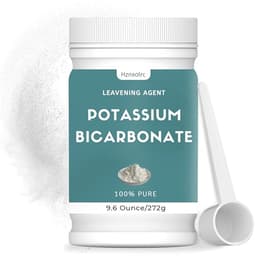
The bicarbonate salt that actually works — what branded organic mildew products (Kaligreen, MilStop, GreenCure) are built on. Mix about 1 tablespoon per gallon with a drop of soap and spray weekly. Far more effective than baking soda, and it feeds potassium rather than sodium.
$12-$20 · Best for The most effective organic powdery mildew treatment
Check price on Amazon →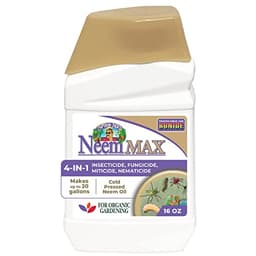
A dual-purpose preventive that suppresses powdery mildew and controls soft-bodied pests. Best applied early and in the evening, never in hot sun. See our neem oil guide for mixing.
$8-$15 · Best for Preventive control plus pest suppression
Check price on Amazon →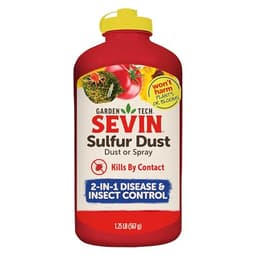
The heavy-duty option for stubborn outdoor mildew on grapes, roses, and cucurbits. Do not use within two weeks of an oil spray or in temperatures above about 85°F, where it can burn foliage.
$10-$18 · Best for Severe outdoor powdery mildew
Check price on Amazon →
The most underrated powdery mildew tool for indoor plants. Moving air breaks up the stagnant humidity mildew needs, and for many houseplant cases it prevents outbreaks better than any spray.
$15-$30 · Best for Preventing indoor powdery mildew via airflow
Check price on Amazon →Treatment information on PlantFix is educational. When using any pesticide — including organic options like neem oil or insecticidal soap — read and follow the entire product label; the label is the law. For persistent or high-stakes problems, your local university extension service offers free, region-specific advice. Read about how we source and verify treatment guidance in our Editorial Standards.
FAQ
Is powdery mildew harmful to humans?▼
No. Powdery mildew fungi are plant-specific and don't infect people or pets, and produce from an affected plant is safe to eat after washing. It's not the same as the household molds that cause respiratory issues. The only real caution is with treatments — follow label directions on sulfur and copper fungicides and let sprayed foliage dry before handling.
Does baking soda work on powdery mildew?▼
Barely, and it can backfire. Sodium bicarbonate (baking soda) sprayed alone performed no better than plain water in field trials and can burn leaves and build up sodium in soil with repeated use. The famous "Cornell Formula" was based on incompletely reported research the original scientist has since disowned. Use potassium bicarbonate instead — it's what the commercial organic mildew products are actually made from, and it works far better while supplying potassium rather than sodium.
Does milk really cure powdery mildew?▼
It genuinely helps — this one isn't folklore. In a 1999 study published in Crop Protection, fresh cow's milk diluted to at least 10% in water and sprayed twice weekly reduced powdery mildew severity on zucchini to about 10%, comparable to conventional fungicides, versus 56% in untreated plants. Mix roughly 1 part milk to 9 parts water and spray in the morning. Keep the concentration under about 30%, above which a harmless surface fungus can develop.
Will powdery mildew kill my plant?▼
Rarely on its own, but it weakens plants and ruins yields if left unchecked. Heavy infection blocks photosynthesis, causing leaves to yellow and drop, which stresses the plant and can severely reduce fruit and flower production. On vegetables like squash and cucumbers it can end a plant's productive life early. It's more disfiguring and yield-robbing than immediately fatal — but worth treating promptly.
Can powdery mildew spread to my other plants?▼
Yes. It spreads readily by airborne spores from plant to plant, favoring crowded, poorly ventilated groupings — though the specific fungus on your squash may differ from the one on your roses, so it doesn't always jump between unrelated species. Isolate heavily infected plants, improve airflow, remove and bag affected leaves rather than composting them, and treat susceptible neighbors preventively during humid spells.
Related
- Plant Diseases: How to Identify and Treat the Most Common Ones →
- Leaf Spot Disease: Fungal vs. Bacterial (ID Chart + Treatment) →
- Tomato Blight: How to Identify, Treat, and Stop Early & Late Blight →
- Anthracnose: How to Identify and Treat It on Every Kind of Plant →
- Blossom End Rot: It's a Watering Problem, Not a Calcium Problem →
- Downy Mildew: Why It's Not Powdery Mildew — and Why That Changes the Treatment →
- Neem Oil for Plants: Complete Guide to Using It Effectively →
- Copper Fungicide: Plant-by-Plant Dosage Chart + Safety Rules →
- Mealy Bugs on Plants: How to Identify & Kill Them Fast →
- How to Fix an Overwatered Plant (Root Rot Rescue) →
- Yellow Leaves on Plants: Every Cause & How to Fix It →
Not sure what's wrong?
Use the diagnosis tool →Get seasonal plant care reminders and pest alerts.