Yellow Sticky Traps for Gnats: Placement & Best Picks
Yellow sticky traps catch fungus gnats — if placed right: flat at soil level, not upright. See the best packs and why traps alone won't end it.
11 min read · Updated 2026-09-10
By PlantFix Editorial Team · Sources: University Extension Programs, USDA, EPA
Do Yellow Sticky Traps Work for Fungus Gnats?
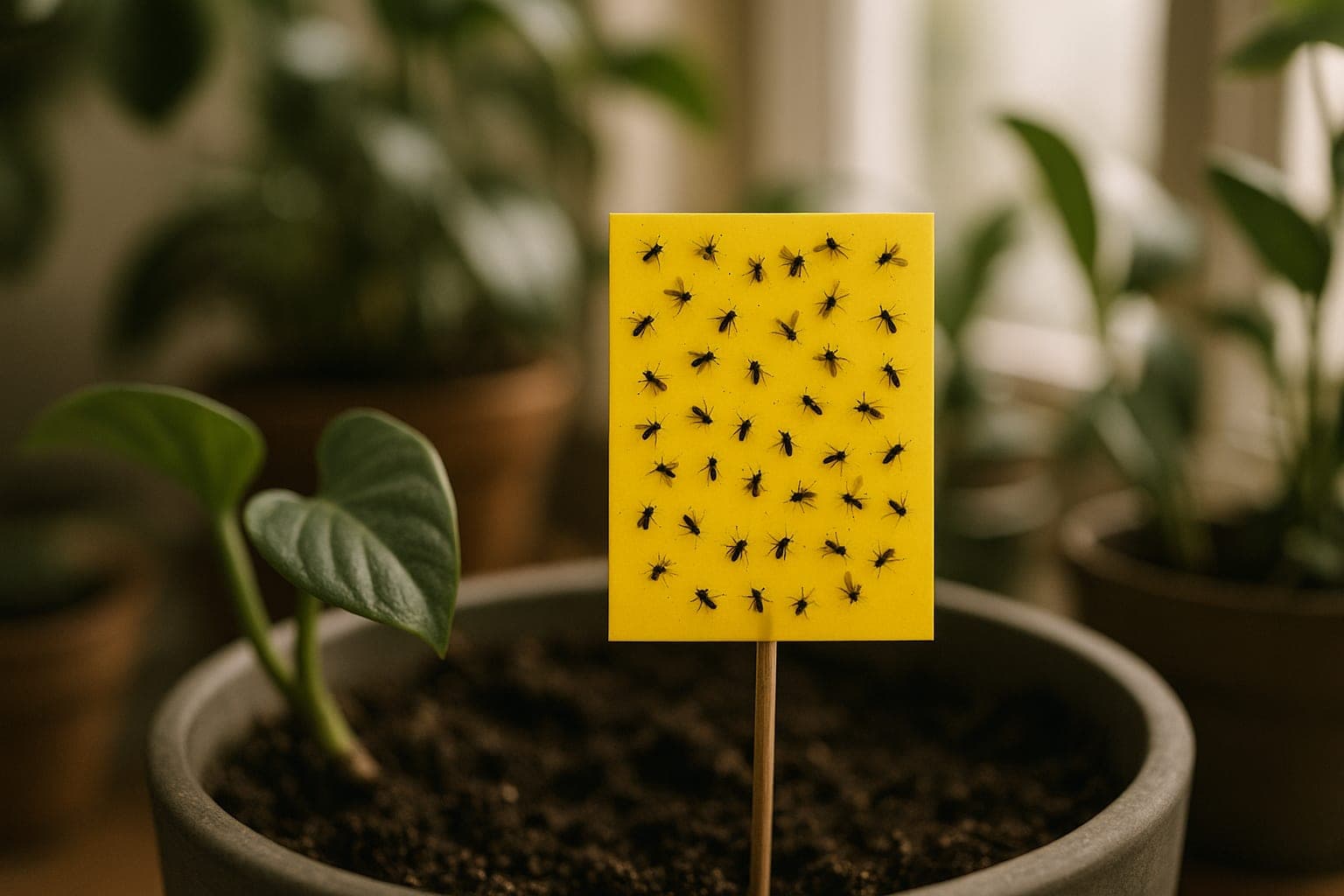
Yes — yellow sticky traps are the single most effective tool for catching adult fungus gnats. They exploit a quirk of gnat biology: fungus gnats are phototactic, meaning they're strongly attracted to yellow wavelengths in the 550-590 nanometer range. A bright yellow surface coated in adhesive catches every adult that lands on it.
The critical placement detail that most people get wrong: lay traps horizontally at soil level, not sticking up vertically above the plant. Research from Ohio State University and UC Davis IPM confirms that horizontal placement near the growing media catches significantly more fungus gnats than vertical placement, because adult fungus gnats spend most of their time near the soil surface where they emerge, feed, and lay eggs. Vertical traps above the canopy miss the majority of the population.
But sticky traps have an important limitation. They only catch adults. They do nothing about the larvae living in the top 2-3 inches of your potting soil — and those larvae are the ones actually damaging roots and sustaining the population. Traps are half the solution. Soil treatment (BTI, hydrogen peroxide drenches, or simply letting soil dry out) is the other half. Used together, you can break the lifecycle in 3-4 weeks.
Why Yellow? The Science of Color Attraction
It's not a marketing gimmick. The yellow color is based on decades of entomological research.
Fungus gnats, whiteflies, leafminers, and many other small flying insects are attracted to specific wavelengths of light in the yellow-green spectrum (550-590nm). This is called positive phototaxis, and the prevailing scientific theory is that these insects are drawn to yellow because it resembles the color of new plant growth and stressed vegetation — signals that indicate suitable feeding and egg-laying sites.
Ohio State University's entomology department published research confirming that yellow traps caught significantly more whiteflies and fungus gnats compared to blue, white, green, or red traps. Blue traps catch thrips more effectively, which is why some commercial growers use blue traps specifically for thrips monitoring. But for fungus gnats, yellow is the clear winner.
The adhesive matters too. Good sticky traps use a UV-resistant, waterproof adhesive that doesn't dry out in sunlight or wash off when you water your plants. The glue should remain tacky for at least 7-10 days. Cheap traps sometimes use an adhesive that hardens within a few days, especially in low humidity — at that point they're just yellow decorations.
One thing that doesn't matter: scent. Unlike ACV traps that attract by smell, sticky traps attract purely by visual stimulus. They're odorless and non-toxic. The yellow color does all the work.
5 Best Yellow Sticky Traps for Houseplants (2026)
I've used most of the popular brands over the past year. Here's how they compare.
Best overall: Gideal 20-Pack Dual-Sided Yellow Sticky Traps. 6x8 inch cards, both sides coated, comes with twist ties for staking in pots. These have the stickiest adhesive of any brand I've tested — gnats that touch them are stuck instantly with no chance of escape. The adhesive stays tacky for 2+ weeks even in dry indoor air. Over 15,000 Amazon reviews at 4.2 stars. They're the standard that other brands imitate. Around $8-10 for 20 traps.
Best for small pots: Flower-shaped sticky stakes (multiple brands — Garsum, LIGHTSMAX, Mosqueda all make them). These are small butterfly or flower-shaped yellow traps on thin stakes that push directly into the pot. They look less industrial than full-size cards and work well for individual houseplants on a shelf or windowsill. Less surface area means they fill up faster with a heavy infestation, but for monitoring and light control, they're perfect. Around $6-8 for 24 stakes.
Best for large plant collections: Gideal or Garsum roll-style yellow tape. Comes as a continuous roll you cut to size. You can hang long strips near plant shelves or lay them flat across multiple pots. More cost-effective per square inch than pre-cut cards. Good for plant shelves, greenhouses, or anyone with 20+ plants. Around $10-14 per roll.
Best budget option: Garsum 30-Pack Dual-Sided Traps. Nearly identical to Gideal at a slightly lower price point per trap. Some users report the protective backing paper is harder to peel off cleanly, but the adhesive quality is comparable. Good if you're buying in bulk for a large collection. Around $8-10 for 30 traps.
Best for outdoor use: Catchmaster gnat traps. Designed for both indoor and outdoor use with a UV-resistant adhesive that holds up in sunlight and rain. More expensive than the basic Gideal/Garsum options but necessary if you're placing traps on a patio, balcony, or in a greenhouse with direct sun exposure.
How to Place Sticky Traps for Maximum Catch (This Is Where Most People Fail)
Placement is the difference between catching a few gnats and decimating the adult population. Get this right and you'll be shocked at how many gnats were flying around your plants.
Rule 1: Horizontal, not vertical. Lay traps flat on the soil surface or suspend them horizontally just above the soil (1-2 inches). UC Davis IPM and Ohio State both recommend horizontal orientation for fungus gnat monitoring because adults emerge from soil, fly low, and frequently rest on the growing media surface. A vertical trap sticking up above the plant catches the occasional gnat that flies high, but misses the majority near the soil.
Rule 2: At soil level, not canopy level. Fungus gnats spend 80%+ of their adult lives within a few inches of the soil surface. That's where they emerge from pupation, that's where females lay eggs, and that's where they rest between short flights. A trap placed at canopy level or hung above the plant is in the wrong zone entirely.
Rule 3: One trap per 2-3 plants in a cluster. If your plants are grouped together, you don't need a trap in every single pot. One standard-size card (6x8 inches) covers a 2-3 foot radius effectively. Space them evenly across your plant collection. For isolated plants, one small stake trap per pot is sufficient.
Rule 4: Replace traps every 7-14 days. Once a trap is covered in dead gnats and dust, it loses stickiness and becomes less visible (less yellow = less attractive). A fresh, clean yellow surface catches more than a dirty one. In heavy infestations, you may need to replace weekly. For ongoing monitoring, every 2 weeks is fine.
Rule 5: Don't put traps directly in the watering path. If water splashes onto the trap every time you water, the adhesive breaks down faster. Position traps slightly offset from the center of the pot, or on the soil surface at the edge of the pot.
Why Sticky Traps Alone Won't Solve a Fungus Gnat Problem
This is the most important section of this entire guide, and it's the context that every product listing on Amazon leaves out.
Yellow sticky traps catch adult fungus gnats. Adults are the gnats you see flying around. But adults aren't the ones doing damage, and killing adults doesn't stop the infestation unless you also address the source: the larvae in the soil.
A single female fungus gnat lays up to 200 eggs in the top layer of moist potting soil. Those eggs hatch in 4-6 days into tiny translucent larvae that feed on organic matter and plant roots for 2-3 weeks before pupating. Even if your sticky traps catch every single adult that emerges, there are already hundreds of eggs and larvae in the soil producing the next generation. The trap catches today's adults while tomorrow's adults are already developing underground.
The real solution is a 3-step system: trap, treat, and prevent.
Step 1 — Trap adults with yellow sticky traps (you're already doing this). This reduces egg-laying pressure and gives you a visual indicator of how bad the problem is and whether it's improving.
Step 2 — Treat the soil to kill larvae. The best options are BTI (Mosquito Bits — soak granules in water for 30 minutes, then water plants with the BTI water), hydrogen peroxide drench (1 part 3% H2O2 to 4 parts water, water plants normally with this solution), or neem oil soil drench. BTI is the most effective because it's a biological control that specifically targets gnat and mosquito larvae. A hydrogen peroxide soil drench is a faster-acting alternative that kills larvae on contact.
Step 3 — Prevent re-infestation by letting the top inch of soil dry out between waterings. Fungus gnats can't lay eggs in dry soil, and larvae can't survive in it. Improve drainage by adding perlite to your potting mix, and always use pots with drainage holes.
Used together, traps and soil treatment break the lifecycle in about 3-4 weeks. Our complete gnat elimination guide walks through every step — one full generation. Used alone, traps just manage the symptoms indefinitely.
DIY Yellow Sticky Trap (Budget Alternative)
If you need a trap tonight and can't wait for Amazon delivery, you can make a functional yellow sticky trap from household materials.
You'll need: a yellow piece of paper or cardboard (construction paper works, or print a solid yellow rectangle on regular paper), petroleum jelly (Vaseline) or a thin layer of cooking oil, and a popsicle stick or chopstick if you want to stake it in the pot.
Smear a thick layer of petroleum jelly on both sides of the yellow paper. Stick it into the soil using a popsicle stick taped to the back, or lay it flat on the soil surface. The yellow attracts fungus gnats and the petroleum jelly traps them.
Does it work as well as a commercial trap? Honestly, no. Commercial traps use a specially formulated adhesive that's far stickier than Vaseline and stays tacky much longer. A Vaseline-based DIY trap catches gnats, but many can pull themselves free because the stickiness isn't as aggressive. The petroleum jelly also gets dusty and ineffective within a couple days.
For a one-night emergency measure, it works. For ongoing gnat management, spend the $8 on a real 20-pack. The commercial traps are genuinely better and last 10 times longer.
Using Sticky Traps to Monitor Infestation Progress
Beyond just catching gnats, sticky traps are a diagnostic tool. They tell you whether your treatment is working.
Week 1 (baseline): Place fresh traps and count how many gnats are caught after 48 hours. Take a photo for reference. This is your baseline population measurement. If you're counting dozens of gnats on a single trap in 48 hours, you have a heavy infestation and need soil treatment in addition to traps.
Week 2 (after first soil treatment): Replace with fresh traps. Count again after 48 hours. If you're also treating the soil (BTI, H2O2, or neem), you should see a noticeable reduction — typically 30-50% fewer adults caught.
Week 3-4: Continue the cycle. The goal is to see declining numbers each week. If you're catching fewer and fewer gnats each time you replace traps, your treatment is working and you're breaking the lifecycle.
Red flag: If numbers aren't dropping after 2 weeks of traps plus soil treatment, something else is going on. Common culprits: you're still overwatering (larvae have moisture to survive), you missed a pot (one untreated plant re-infests the others), or the potting mix is so organic-rich that larvae have endless food even with treatment. In that case, consider repotting the worst offenders into fresh, well-draining mix.
Green flag: When you see zero or 1-2 gnats on a trap after 7 days, the infestation is essentially broken. Keep traps in place for another 2-3 weeks as a monitoring tool, but you can stop soil treatments.
What Else Yellow Sticky Traps Catch
Yellow sticky traps aren't picky. They'll catch anything small and flying that's attracted to yellow light wavelengths. Here's what you might find on your traps besides fungus gnats.
Whiteflies: Tiny white moth-like insects, about 1/16 inch. If you see these, check the undersides of your plant leaves for more — they cluster there and fly off in a white cloud when disturbed. Our spider mites guide covers treatment overlap.
Fruit flies: Small, tan or brown flies with red eyes. If your sticky traps near plants are catching more of these than fungus gnats, you probably have a fruit source (overripe fruit, open compost) attracting them. An ACV trap near the fruit bowl is a better targeted solution.
Shore flies: Slightly larger and stockier than fungus gnats, with distinctive white spots on their dark wings. They indicate very wet conditions and algae growth on your soil surface. Less damaging than fungus gnats but a sign of chronic overwatering.
Thrips: Tiny, slender insects barely visible to the naked eye. If you're catching thrips, blue sticky traps actually work better than yellow for this specific pest. But yellow traps will still catch some.
Leafminers: Small flies whose larvae create distinctive serpentine trails inside leaves. If you see these on your traps, check your plant leaves for squiggly white or brown trails — that's where the larvae have been feeding between the leaf surfaces.
Recommended Products
We earn a commission if you buy through these links, at no extra cost to you. We recommend based on what works, not what pays. How this works.
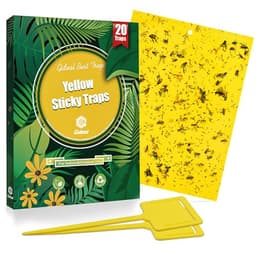
The most popular option for a reason — aggressive adhesive that stays tacky for 2+ weeks, dual-sided for maximum surface area, and comes with twist ties for staking. Over 15,000 Amazon reviews at 4.2 stars. Works for fungus gnats, whiteflies, aphids, and leafminers.
$8-$10 · Best for Best overall for most houseplant owners — effective and affordable
Check price on Amazon →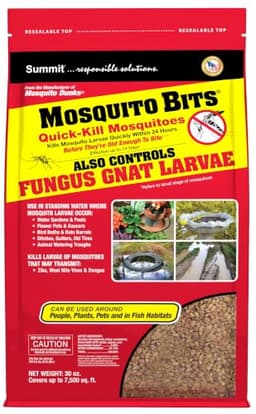
The soil treatment that makes sticky traps actually solve the problem. Contains Bacillus thuringiensis israelensis that specifically kills fungus gnat larvae in the soil. Soak granules in water for 30 minutes, then water plants with the BTI solution. Non-toxic to plants, pets, and people.
$8-$15 · Best for Killing larvae in soil — the essential companion to sticky traps
Check price on Amazon →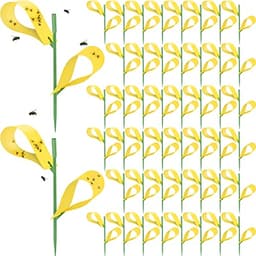
Small butterfly or flower-shaped yellow traps on thin stakes that push directly into the pot. Less surface area than full-size cards but more visually appealing for a living room windowsill. Good for individual plant monitoring and light infestations.
$6-$8 · Best for Small pots and individual plants — aesthetic-friendly option
Check price on Amazon →Treatment information on PlantFix is educational. When using any pesticide — including organic options like neem oil or insecticidal soap — read and follow the entire product label; the label is the law. For persistent or high-stakes problems, your local university extension service offers free, region-specific advice. Read about how we source and verify treatment guidance in our Editorial Standards.
FAQ
Do yellow sticky traps work for fungus gnats?▼
Yes — they're the most effective tool for catching adult fungus gnats. The yellow color exploits their natural attraction to yellow wavelengths (550-590nm). Place them horizontally at soil level for best results, not vertically above the plant. They catch adults but don't kill larvae in the soil, so combine with BTI (Mosquito Bits) or hydrogen peroxide drenches for complete control.
Should sticky traps be horizontal or vertical for fungus gnats?▼
Horizontal, at or just above soil level. Research from Ohio State University and UC Davis IPM confirms that horizontal placement catches significantly more fungus gnats because adults spend most of their time within a few inches of the soil surface. Vertical traps above the plant canopy miss the majority of the gnat population.
How often should you replace yellow sticky traps?▼
Every 7-14 days. Once a trap is covered in dead gnats and dust, it loses stickiness and yellow visibility. During heavy infestations, check every 3-5 days and replace when more than 50% of the surface is covered. For ongoing monitoring after the infestation is controlled, every 2 weeks is sufficient.
How many sticky traps do I need per plant?▼
For clustered plants, one standard 6x8 inch trap per 2-3 plants is effective. For isolated plants on their own, one small stake-style trap per pot works. If you have a large plant shelf or collection of 20+ plants, use 3-4 full-size cards placed horizontally at even intervals across the shelf.
Are yellow sticky traps toxic to pets or children?▼
No. Yellow sticky traps are non-toxic — they use physical adhesive only, no pesticides or chemicals. If a child or pet touches the sticky surface, remove with vegetable oil or cooking spray, which dissolves the adhesive. The main risk is a messy pet fur situation, not a health hazard. Keep traps inside pots or behind plants if curious pets are a concern.
Related
- Fungus Gnats: How to Identify & Eliminate Them for Good →
- Apple Cider Vinegar Gnat Trap: The Recipe That Works in Hours →
- Gnats vs Fruit Flies: How to Tell the Difference in 10 Seconds →
- Tiny Black Bugs on Plants: Identify & Get Rid of Gnats, Thrips & More →
- Plant Bugs: Identify Any Bug on Your Plant in 30 Seconds →
- Best Indoor Fly Traps for Plant Owners (2026): What Actually Works →
- Hydrogen Peroxide for Fungus Gnats: The Exact Ratio & Why It Fails for Some People →
- Whiteflies: The Shake Test, Damage Chain & 3-Week Treatment Protocol →
- Mosquito Bits for Fungus Gnats: Dosage + 24-Hour Kill →
- Houseplant Pests: Visual ID Guide to Every Bug on Your Indoor Plants →
- Leaf Miners: Those Squiggly White Lines on Your Leaves (ID + Treatment) →
Not sure what's wrong?
Use the diagnosis tool →Get seasonal plant care reminders and pest alerts.